Showing posts with label Cow protection. Show all posts

Tuesday, 13 February 2018

Haryana Government brings law on abandoning cows

Haryana government to impose Rs 5100 fine on those abandoning milch cows

Senior official of Haryana government stated on Monday, that People who abandoning milch cows in Haryana will have to pay a fine of Rs 5,100. The state will also provide a concession on products made from cow dung and urine. Following the steps of Haryana, Uttar Pradesh government has ordered the same and 8 medical collages will prepare the Ayurvedic medicine.


Haryana government to impose Rs 5100 fine on those abandoning milch cows

On Monday, a senior official of Haryana government stated that people who abandoning milch cows in Haryana will have to pay a fine of Rs 5,100. “For this purpose, a mobile application is being prepared with the assistance of information technology cell in the state, which will reveal information about the location of the animal on the basis of a tag number,” said Bhani Ram Mangla, Chairman, Haryana Gau Seva Aayog. Bhani Ram Mangla also added to his statement that as per government decision, Gau Seva Kendra will be established in the villages of Haryana for cow fostering and government will assist the financial assistance.
“Registration of these centres will be mandatory and a committee of learned persons will be set up for their functioning. The Aayog will give a lump sum amount of Rs 5,000 per cow annually,” Gau Seva Kendra, chairman. Reporting to media persons, Bhani Ram Mangla said that 90% of the grant will be given on equipment that are used for making products like soaps, lamps and incense from cow dung and urine.
Following the steps of Haryana, Uttar Pradesh government has also shown a thumbs-up to this decision and gave a push to the use of cow urine in preparing medicines. 8 Ayurvedic medical colleges in the state Banda, Jhansi, Muzaffarnagar, Allahabad, Varanasi, Bareilly, Lucknow and Pilibhit, will work on this. States ruled by Bharatiya Janata Party such as Uttar Pradesh, Haryana, and Madhya Pradesh have introduced many schemes to preserve cows.
Earlier, Member of Parliament Subramanian Swamy has pressured the lawmakers to withdraw a bill to ban cow slaughter. This bill demands a mandatory death penalty to accused of killing the animals.

Sunday, 13 August 2017

The Mundari: The tribe dying for their cows

http://edition.cnn.com/2016/04/22/africa/mundari-tribe-cattle-photography/index.html

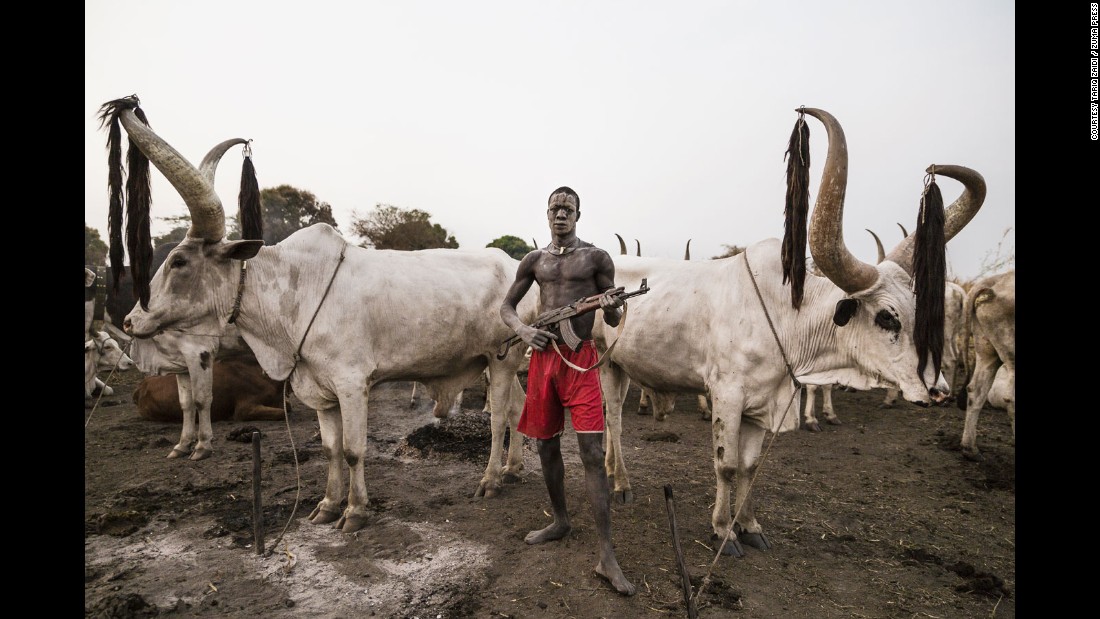
A Mundari man guards his precious Ankole-Watusi herd with a rifle. Photographer <a href="http://www.tariqzaidi.com/" target="_blank">Tariq Zaidi</a> visited the Mundari tribe in South Sudan twice in 2016 to document the lives of these fiercely protective herdsmen who face war, rustlers and landmines as they care for their animals.


South Sudan is the world's youngest country, and it has witnessed immense change since gaining independence in 2011. The promise of peace has given way to civil war, and tribal rifts continue to run deep, permeating political affairs. Over two million people have been displaced according to the UN, and tens of thousands killed.


    Amid the tumult is the Mundari, a people who would rather get on with doing what they do best: looking after their cattle.
    It would be hard to find a more dedicated group of herdsmen than the tribe who live on the banks of the Nile, north of the capital Juba. Their entire lifestyle is geared around caring for their prized livestock, the Ankole-Watusi, a horned breed known as "the cattle of kings."
    These cows grow up to eight feet tall, and are worth as much as $500 each. It's no wonder the Mundari view these animals as their most valuable assets (or that they guard them with with machine guns).
    Photographer spent a fortnight earlier this year documenting their lives and the devotion they show towards these animals. Photographer has captured tribes and indigenous people from over 30 African nations, though he was nonetheless taken aback by the relationship between man and beast.
    "It's hard to overstate the importance of cattle to the Mundari people," says the photographer, "these animals are everything to them."
    The photographer describes how "almost every man I met wanted me to take a picture of them with their favorite cow." Their wives and children, on the other hand, were given short shrift.
    Perhaps this is in part due to the function and symbolism of the Ankole-Watusi. Each bovine is so highly prized that it is rarely killed for its meat. Instead, it is a walking larder, a pharmacy, a dowry, even a friend. It is clear that cow is a resource maintaining not just a people, but a way of life.
    The Mundari, tall and muscular, may "look like bodybuilders," says Zaidi, "but their diet is pretty much milk and yogurt. That's it." Other bodily fluids have more unlikely uses. Mundari men will squat under streams of cow urine, both an antiseptic, Zaidi suggests, and as an aesthetic choice -- the ammonia in the urine color the Mundari's hair orange.
    Meanwhile dung is piled high into heaps for burning, the fine peach-colored ash used as another form of antiseptic and sunscreen by the herdsmen, shielding them from the 115-degree heat.
    The cows, adds Zaidi, are among the world's most pampered. He says he witnessed Mundari massaging their animals twice a day. The ash from dung fires, as fine as talcum powder, is rubbed into the cattle's skin and used as bedding, while ornamental tassels swat flies from the eyes of the herd's most prestigious beasts.
    "Rustlers are a huge issue for them," the photographer explains. "Their cattle are a form of currency and status symbol, and form a key part of a family's pension or dowry. Since the end of the civil war, thousands of men have returned to South Sudan looking for wives, which has pushed up the 'bride price', making these animals even more precious and increasing lethal cattle raids."
    Such raids have been deadly for the Mundari, but the effects of war are manifold. Landmines make finding fresh pasture a dangerous lottery. When he visited, Zaidi says the tribe were using a small island in the Nile as a safe haven. The conflict, he adds, has the paradoxical effect of preserving their way of life.
    "The ongoing war in South Sudan has cut off the Mundari tribe from the rest of the world," he says. "They don't venture into the town, they stay in the bush, and it's why their unique way of life endures."
    Zaidi says the Mundari have no taste for war and "their guns are not to kill anyone but to protect their herd." All the Mundari want to do is take care of their livestock, he argues, "and they will protect them at all costs."

    Tuesday, 7 June 2016

    Bhakti-yoga and Cows


    A) SAMBANDHA JNANA & cow protection:
    gov anga yavasadina (SB 11.11.43)
    I can be worshiped within the cows by offerings of grass and other suitable grains and paraphernalia for the pleasure and health of the cows,

    (How can this be called as being related to Sambandha-jnana? Because, "Bhakti-yoga that is performed for the satisfaction of the Supreme Lord VAsudeva brings about detachment from all things unrelated to Him and gives rise to pure knowledge that is free from any motive for liberation and directed exclusively towards the attainment of Him" Srimad Bhagavatam, 1.2.7)

    B) ABHIDHEYA & cow protection
    **** (I) Gomata - a partner in Vaidhi sadhana bhakti:

    (a) 10th principle of vaidhi sadhana bhakti (Bhakti Rasamrta Sindhu,1.2.110_:
    aSvattha tulasI dhAtri go bhUmis sura vaiSNavAH
    pUjitAH praNatAH dhyAtAH kSapayanti nRNAm agham
    In the Skanda Pur€Ša it is directed that a devotee should offer water to the tulas… plant and €malaka trees. He should offer respect to the cows and to the br€hmaŠas and should serve the VaiŠavas by offering them respectful obeisances and meditating upon them. All of these processes will help the devotee to diminish the reactions to his past sinful activities.

    (b) Srimad bhagavatam, Go-seva:
    uktam bhAgavatam nityam kRtam ca hari chintanam
    tulasI poSaNam caiva dhenunAm sevanam samam
    Reciting Srimad Bhagavatam daily, remembering Lord Hari constantly, nourishing the Tulasi plant, protecting and caring for the cows, are all equally beneficial (because these acts are pleasing to Krsna) (Bhagavata mahatmya, verse 40).

    (c) Daivi sampat qualitites imbibed due to association of mother cow

    dhairyaM dhRtiSca SAntiSca puSTirvRddhiH tathaiva ca
    smrtirmedhA tathA lajjA vapuH kIrtistathaiva ca
    vidyA SAntirmatiScaiva santatiH paramA tathA
    yatra gAvastatra lakSMIH sAnkhyAdharmASca SASvataH
    (VarAha PurANa, 206.34-35)

    By associating with the cows, by serving the cows and by consuming milk and milk products, it is said that one will be endowed with fearlessness, tolerance, peacefulness, strength, sharp memory, intelligence, shyness to act irreligiously, humility, health, fame, knowledge and progeny. Wherever there are cows, there is all prosperity and eternal spiritual knowledge.

    (d) DAsyam (of sadhana bhakti) and cow protection:
    karma svAbhAvikam bhadram (Bhakti Rasamrta Sindhu, 1.2.185)
    To follow svabhava karma (daiva varnasrama dharma) for pleasure of Krsna. Varna samanya dharma (common dharma for all is 'cow protection' and 'growing food' (meaning, not for trade but for self-sufficiency. Trade is exclusive domain of mercantile class)
    kRSistu sarva varNAnAM sAmAnyo dharma ucyate
    kRSrbhRtiH pASupAlyam sarveSAM na niSidhyate
    Agriculture and cow protection are common duty for all the varNAs and they are not prohibited for anyone (VRddha HArita SmRti)

    **** (II) Gomata - a partner in Raganuga sadhana bhakti

    ++ tat-prApty-utkaNTAyAm ekAdaSI-janmASTmI-kArttika-vrata-bhoga-tyAgAdIni tapo-rUpANi tathASvattha-tulasy-Adi-sammAnanAdIni tad-bhAvAnukUlAny eva
    The observance of Ekadasi, Janmastami, Kartikka vrata as well as the renunciation of sense pleasures and other austerities, offering respect to Tulasi, the banyan tree, cows etc.; all of these activities executed with eagerness for attaining one's most cherishable relationship with the Desired Object, because they are helpful and favourably disposed towards the attainment of this bhava are called BhAvAnukUla sAdhana (Bhakti Rasamrta Sindhu Bindu, Srila Visvanatha Cakravarthi Thakura)

    ++ A devotee may be desiring to associate with the Personality of Godhead as His cowherd friend. He will want to serve the Lord by assisting Him in controlling the cows in the pasturing ground. This may appear to be a desire to enjoy the company of the Lord, but actually it is spontaneous love, serving Him by assisting in managing the transcendental cows (Srila Prabhupada, Nectar of Devotion, Chapter 15)


    **** (III) Gomata - a partner in Bhava bhakti

    ++ Impetus (Uddipana) - "Uddipana-vibhava to bhava bhakti
    ye kRSNas smArayanti te uddIpana vibhAva
    Refers to all those things which stimulate remembrance of Sri Krsna such as His dress and ornaments, the spring season, the bank of the Yamuna, forest groves, cows, peacocks, and so on." (Srila Visvanatha Cakravarthi Thakura, Bhakti Rasarmta Sindhu Bindu)


    C)PRAYOJANA & cow protection:

    **** (IV) Gomata - a partner in Prema Bhakti

    ++ Santa-rasa and cows:
    (a)Impetus for santa-rasa and cows:
    parvata-Saila-kAnanAdi-vAsi-jana-saNga-siddha-kSetrAdayaH uddIpana-vibhAvAH
    To live in pure and natural atmosphere devoid of crowded congestion of cities. Such places are known as vivikta deSa full of trees and natural surroundings (just like forests of Vrindavan).
    (Of with course cows in such peaceful living. After all, that is how great rsis lived in the past).

    (b)Cows gave pleasure to Krsna in SAnta-rasa (Hence worthy of our service):
    The land, the grass, the trees, the plants, fruits, or the cows in the transcendental world are supposed to be situated in the santa rasa. As spiritual beings, they are all conscious of Krsna, but they prefer to appreciate Krsna greatness remaining as they are (Srila Prabhupada, Letter to Rupanuga, 12 Mar, 1968).

    ++ Impetus for Dasya-rasa and cows:
    (a)Reverential affection to see Krsna as a cowherd boy:
    "When will that glorious day in my life come when it will be possible for me to go to the bank of the Yamuna and see Lord Krsna playing there as a cowherd boy?"

    ++ Impetus (Vibhava) and Anubhava in Sakhya-rasa and cows:
    (a)"Krsna going into the forest to tend the cows" is an impetus for sakhya-rasa.
    vrndAraNye samastAt surabhiNi surabhIvrndarakSAvihAri (Bhakti Rasamrta Sindhu, 3.3.66)

    (b)Anubhava symptom in sakhya rasa and cows:
    puras tairyatrikaM tasya gavAM sambhAlanakriyAH
    "Helping Krsna herd His cows" (Bhakti Rasamrta Sindhu, 3.3.95)


    ++ vatsalya rasa and cows
    According to Srila Visvanatha Cakravarti Thakura, the cows loved Lord Krsna in vatsalya-rasa, or the love of parents for a child, because the cows were always supplying milk to Krsna.

    Impetus for vatsalya rasa and cows/calves:
    vatsarakSA vrajArbhyeNa (Bhakti Rasamrta Sindhu, 3.4.32)
    Krsna protecting and herding calves in the forests, is an impetus for Vatsalya rasa.


    ++ Impetus for Madhurya rasa and cows:
    The impetuses of conjugal love are Krsna and His very dear consorts, such as Radharani… and Her immediate associates (who are all gopis, or cowherd women)

    Dear Krsna, what woman in all the three worlds wouldn't deviate from religious behavior when bewildered by the sweet, drawn-out melody of Your flute? Your beauty makes all three worlds auspicious. Indeed, even the cows, birds, trees and deer manifest the ecstatic symptom of bodily hair standing on end when they see Your beautiful form (Srimad Bhagavatam, 10.29.40)

    When one gopi perfectly imitated how Krsna would call the cows who had wandered far away, how He would play His flute and how He would engage in various sports, the others congratulated her with exclamations of "Well done! Well done!" (Srimad Bhagavatam, 10.30.18)

    Your lotus feet destroy the past sins of all embodied souls who surrender to them. Those feet follow after the cows in the pastures and are the eternal abode of the goddess of fortune. Since You once put those feet on the hoods of the great serpent Kaliya, please place them upon our breasts and tear away the lust in our hearts (Srimad Bhagavatam, 10.31.7)

    Dear master, dear lover, when You leave the cowherd village to herd the cows, our minds are disturbed with the thought that Your feet, more beautiful than a lotus, will be pricked by the spiked husks of grain and the rough grass and plants (Srimad Bhagavatam, 10.31.11)

    **** Tending cows - natural occupation of Krsna in Goloka Vrndavana

    cintamani-prakara-sadmasu kalpavriksha-
    lakshavrteshu surabhir abhipaalayantam
    lakshmi-sahasra-sata-sambhrama-sevyamanam
    govindam aadi-purusham tam aham bhajami

    “Lord Krishna is situated in a spiritual abode made of transcendental gems. In that abode he is surrounded by millions of desire fulfilling trees (kalpa-vriksha), and he takes pleasure in tending the divine cows. He is always being served with great reverence and affection by hundreds of thousands of devotees. To that Supreme Lord, who is always trying to satisfy the senses of the cows, and who is the original person, I offer my worship.”

    [Brahma-samhita]


    Ofcourse not touching about Karma-kanda, Jnana-kanda and cows.

    Saturday, 24 October 2015

    Red meat triggers toxic immune reaction which causes cancer, scientists find

    The body views red meat as a foreign invader which must be stamped out
    http://www.telegraph.co.uk/news/health/news/11316316/Red-meat-triggers-toxic-immune-reaction-which-causes-cancer-scientists-find.html
    Red meat has been linked to cancer for decades, with research suggesting that eating large amounts of pork, beef or lamb raises the risk of deadly tumours.
    But for the first time scientists think they know what is causing the effect. The body, it seems, views red meat as a foreign invader and sparks a toxic immune response.
    Researchers have always been puzzled about how other mammals could eat a diet high in red meat without any adverse health consequences.
    Now they have discovered that pork, beef and lamb contains a sugar which is naturally produced by other carnivores but not humans.
    It means that when humans eat red meat, the body triggers an immune response to the foreign sugar, producing antibodies which spark inflammation, and eventually cancer.
    In other carnivores the immune system does not kick in, because the sugar – called Neu5Gc – is already in the body.
    Scientists at the University of California proved that mice which were genetically engineered so they did not produce Neu5Gc naturally developed tumours when they were fed the sugar.
    "This is the first time we have directly shown that mimicking the exact situation in humans increases spontaneous cancers in mice,” said Dr Ajit Varki, Professor of Medicine and Cellular and Molecular Medicine at the University of California.
    "The final proof in humans will be much harder to come by.
    "This work may also help explain potential connections of red meat consumption to other diseases exacerbated by chronic inflammation, such as atherosclerosis and type 2 diabetes.
    "Of course, moderate amounts of red meat can be a source of good nutrition for young people. We hope that our work will eventually lead the way to practical solutions for this catch-22."
    Red meat is a good source of protein, vitamin and minerals, but an increasing body of research suggests too much is bad for long-term health.
    Health experts recommend eating no more than 2.5oz (70g) a day, the equivalent of three slices of ham, one lamb chop or two slices of roast beef a day
    A study published by Harvard University in June suggested that a diet high in red meat raised the risk of breast cancer for women by 22 per cent.
    In 2005 a study found those who regularly ate 5.6oz (160g) of red meat a day had one third higher risk of bowel cancer.
    The average person in the UK has 2.5oz (70g) meat a day 3oz (88g) among men, 2oz (52g) among women) but 33 per cent have more than 3.5oz (100g) a day.
    Previous research has suggested that a pigment in red meat may also damage the DNA of cells lining the digestive system.
    The new research was published online in the journal, Proceedings of the National Academy of Sciences.

    Monday, 12 October 2015

    Beef eating bad for environment, says United Nations body


    Beef eating bad for environment, says United Nations body
    http://www.indiatvnews.com/news/india/beef-eating-bad-for-environment-united-nations-55199.html
    Beef eating has impassioned the nation, with politicians of all hues duelling like bulls in rage. Religious taboos are one aspect, but there is also a very strong environmental angle for not eating beef.
    The United Nations Environment Program (UNEP) has dubbed beef as a 'climate-harmful meat'. It is very energy intensive to produce every gram of beef, on an average every hamburger results in 3 kg of carbon emissions to the atmosphere. Today, saving the planet is really about ensuring sustainable consumption and meat production is, unfortunately, a highly energy intensive exercise.
    eat eaters in general and beef eaters, in particular, are among the most unfriendly to the global environment, reports the United Nations body, the Food and Agriculture Organisation (FAO) in Rome. It may come as a surprise, but globally beef production is one of the leading culprits for climate change. Some even suggest that beef is the devil or the 'shaitan' of the meat production industry. That having said, the lynching of a man on the suspicion that he consumed beef can never be justified in any society.
    Experts suggest that giving up beef will reduce the global carbon footprint on earth far more than avoiding the use of cars!
    Here is why, if one examines the numbers closely livestock production contributes more towards global warming than does the transport sector in total, through emissions of gases that result in changing the climate.
    According to FAO, the livestock sector is responsible for 18% of the global greenhouse gas emissions as compared to the transport sectors' 15%. In a study 'Livestock's Long Shadow: Environmental Issues and Options', the FAO concludes that "the livestock sector is major player (and its contributions to climate change has) a higher share than transport".
    Earth lovers are voicing their concern and shaming meat eaters, most recently Laurence Tubiana. The charismatic French Ambassador for Climate Change Negotiations for the big climate summit to be held in a few weeks in Paris said, "This over consumption of meat is really killing many things (there has to be a campaign) that big meat consumers should stop that. At least try one day without meat."
    According to a 2012 estimate by Ministry of Agriculture, India is home to 512 million livestock of which cows and buffaloes together account for 111 million animals. Most of the animals in India are not reared for slaughtering but prized for milk and ploughing. UNEP estimates that in 2012 the world was home to 1.43 billion cattle.
    So do not start feeling guilty that Indians are highly environment-friendly when measured on the scale of meat eating and livestock numbers. A landmark 2012 study 'Growing greenhouse gas emissions due to meat production' by UNEP finds that on an average Indians consume only 12 grams of meat per person per day which is almost 10 times lower than the global average of 115 grams.
    In comparison, the US leads with over 322 grams of meat being eaten per person per day with China at about 160. Hence, on an average a meat-eating American contributes 25 times more to global warming as compared to a non-vegetarian Indian.

    A 2012 estimate by the Department of Animal Husbandry, Dairying and Fisheries says the country produced 5.9 million tonnes of meat of which poultry's (mostly chicken) contribution to the total meat production is about half with less than 5 % of the meat coming from beef.
    In comparison in 2009, the world produced 278 million tonnes of meat, which means that India accounts for just about 2 % of the world's meat production while housing 17 % of the world's population. There is no doubt that meats provide the vital protein and nutrients needed for proper human development. Milk is a healthy substitute.
    It may sound astounding but beef production on an average requires 28 times more land and causes 11 times more global warming as compared to other livestock categories found a 2014 study by the prestigious Yale University in US, published in the Proceedings of the National Academy of Sciences which concluded that "minimising beef consumption mitigates the environmental costs of diet most effectively".
    Tim Benton of the University of Leeds, UK, not associated with US study felt "the biggest intervention people could make towards reducing their carbon footprints would not be to abandon cars, but to eat significantly less red meat".
    Beef production is also bad for water conservation since cattle rearing for beef require almost 10 times more water as compared to staple crops like wheat and rice. In contrast, pork production uses three times less water as compared to beef ranching. Cattle also emit a highly potent climate-changing gas called 'methane' in their farts and through belching. Also called 'marsh gas' this inflammable gas is produced in the guts of cattle by the bacteria as they digest the food of ruminants and methane is 21 times more potent than carbon-di-oxide in causing global warming.
    Using data from a Swedish study the UNEP says "in terms of greenhouse gas emissions the consumption of 1 kg domestic beef in a household represents automobile use of a distance of 160 kilometers".
    This means a car travelling all the way from New Delhi to Agra would cause about the same amount of global climate change as is done by consuming just one kg of beef! No wonder beef is considered highly environmentally un-friendly.
    Nevertheless, at the same time in dry and arid regions of the world livestock are considered a 'savings bank' by local people as they form part of the life-saving kit to overcome the harsh environment.
    Meat eating may not be 'green' but as more and more people become affluent, meat is becoming chic and fashionable. FAO estimates that by 2050 the global meat consumption will rise to 460 million tonnes. The global environment watchdogs the UNEP recommends a shift to 'less climate-harmful' meats and emphasises that "healthy eating is not just important for the individual but for the planet as whole". 

    Thursday, 10 September 2015

    Beef Ban pan state of Jammu & Kasmir! Hurray!

    http://www.ibnlive.com/news/india/jk-hc-bans-beef-across-the-state-asks-government-to-strictly-follow-orders-1090487.html

    Map of jammu and kashmir state


    Srinagar: The Jammu and Kashmir High Court on Wednesday banned the sale of beef across the state. It has also asked state government to take steps to ensure that the ban is strictly implemented.
    The order stating the ban was issued by divisional bench of J&K High Court while hearing a petition which sought ban on sale and consumption of beef.
    Despite the orders issued on Wednesday, beef shops in the state remained open on Thursday.
    Meanwhile, the Peoples Democratic Party-Bharatiya Janata Party government has not reacted to the ban so far. Enforcing the ban will be a huge task for the government in a state where majority of the population consumes beef.
    Earlier, the Haryana and Maharashtra government had imposed a complete ban on the sale of beef in any form in the state.
    It also comes at a time when the Bharatiya Janata Party is under fire for banning meat in Mumbai for 4 days during the Jain festival of Paryushan.

    Saturday, 22 August 2015

    PMO Seeks New Cowboys as Saviors

    Roadbloack is the mother of the BJP-led Central government’s innovation. After deciding to put on hold the proposed national ban on cow slaughter due to political and legal reasons, it is coming up with innovative ways to encourage cow rearing while taking measures to discourage killing of cows.
    Taking the lead in this is the Prime Minister’s Office (PMO). It has asked Minister of Agriculture Radha Mohan Singh and various other ministries, including the Ministry of Health and Family Welfare, to come up with “innovative ideas” to make cow rearing a profitable practice. The directive came after the Ministry of Law and Justice opposed a national ban on the killing of cows. The ministries have also been asked to think out of the box and do “serious research” to find out more about productive ways in which cow waste can be used.
    The ministries are doing exactly that. The Ministry of Agriculture has decided to encourage production and marketing of products made from cow dung and urine. The government will also encourage marketing of a cleaning liquid made from a mixture of cow urine, neem and a fragrant that can replace phenyl.
    “While phenyl is made out of chemicals not good for human health, this liquid is 100 per cent natural. Cow urine has inherent medicinal components, which should make it more attractive,” said an official with the ministry. He added that the product will be available at all kendriya bhandars across the country and will be made mandatory in all government spaces.
    The government also plans to give subsidies to NGOs working in this area. “Making products out of cow urine and cow dung will make cow rearing a more lucrative proposition. The government hopes to dissuade farmers from selling cows when they become old. It will also help gaushalas across the country,’’ the official added.
    http://www.newindianexpress.com/thesundaystandard/PMO-Seeks-New-Cowboys-as-Saviors/2015/08/23/article2988259.ece

    Friday, 15 May 2015

    Toyota Shows How Their Car Runs on Cow Manure!

    https://www.youtube.com/watch?v=9pTluy9KpYU


    There are those who don't believe that hydrogen, as an alternative fuel, is a feasible source. Yes, Elon Musk and Carlos Ghosn, we are looking at you. But for all these non-believers, Toyota came out with an answer in the form of the fuel-cell car - Mirai, which has already seen the light of production in Japan but the company has plans to introduce it in other markets soon.
    As part of their Earth Day promotions, the company released the first episode of its series of Toyota Mirai ads called 'Fueled By Everything'. With this ad it tries to prove how hydrogen can be stripped from cow manure to power the Toyota Mirai.
    It's very clear that through these ads, Toyota takes the cheeky road for there are many who have called hydrogen a bullshit fuel source. So the apt thing to do here was prove that it is indeed bullshit that powers the Toyota Mirai. The video essentially shows how hydrogen can be harnessed by processing cow manure, and therefore says that it isn't all that difficult.

    Toyota Shows How Their Car Runs on Cow Manure

    The Mirai is the Japanese carmaker's first mass-production hydrogen-powered fuel-cell car, and it comes after 20 years and millions of dollars of investment in research and development. This is how it basically works.

    The gas goes through a hydrogen fuel cell stack that mixes oxygen with the hydrogen and this reaction, in turn, generates electricity to charge the on-board battery. The Toyota Mirai is powered by a 114 kilowatt fuel cell stack along with a 113 kilowatt electric motor on board. The combination of hydrogen and oxygen creates pure water, which is dumped via the tailpipe while driving or when the vehicle is parked.
    According to Toyota, 0-100Km/h takes around 10 seconds and the range expected from the car in real world driving conditions is about 550km. If you were wondering how long it takes to refill the tank, well you'll be surprised if I say 5 minutes. Currently Japan has only 10 hydrogen stations, though there's a plan to take that number up to 100 by the end of 2015.
    The car is currently priced at around Rs. 35 lakh in Japan and the price could dip a little with select markets offering government incentives.

    Wednesday, 11 March 2015

    Family of six lives off less than $90 a week!

    SELF-SUFFICIENT: The Vinbrux family, from left, Christel, Judy, Richard, Danny and Sarah.

    http://www.stuff.co.nz/life-style/nz-life-leisure/66872932/family-of-six-lives-off-less-than-90-a-week

    They're an intriguing family, the Vinbruxes. There's an Amish look to their hairstyles and clothing. You can put that down to home barbering and wardrobes from local op shops. From their conversation and the books on theirshelves it's clear that they're well educated. Richard gained a degree in agriculture and qualified as a master baker in Germany and produces fabulous fare for the weekly Oamaru Farmers' Market while Christel holds a Masters in home economics from Germany and there's nothing she can't do with raw ingredients to make delectable meals.  
    Christel and Richard arrived in Oamaru in 1998 with the first four of their five children, bought 12.5 hectares of undulating farmland, set up an Icelandic horse stud to generate an income and began farming according to the biodynamic principles of Austrian philosopher Rudolf Steiner. Their home is built from logs and furnished with rustic German antiques. A reconditioned Shacklock stove cooks the food and heats the house. Pitch-roofed outhouses in the yard are painted in fanciful colours. One of these is a bakery with a wood-fired brick oven while another is a dairy equipped for producing cheeses, yoghurt, separated cream and milk. There's a brew house for making hooch. 
    Weekly grocery bills for the household of six plus a few Woofers (Willing Workers on Organic Farms) come to about $90, which covers such staples as flour, rice, salt, sugar and olive oil. Other than that, they eat what they grow in the vegetable gardens and raise in the paddocks. Most of the land is in pasture that supports the livestock: horses, sheep, cattle, pigs, hens, goats, bees, geese, turkeys, ducks and pigeons. There are any number of mouser cats with dogs for stock work and companionship. Over the years they've planted a 1.5-hectare mixed wood lot, a half-hectare orchard and another half hectare in vegetable beds.
    THE SIMPLE LIFE: "Most of the time we can live quite comfortably off the smell of the rag that was lying next to the oily one," Richard says.
    Tessa Chrisp
    THE SIMPLE LIFE: "Most of the time we can live quite comfortably off the smell of the rag that was lying next to the oily one," Richard says.
    Running a small farm like this is a full-time job for several people. Christel describes their daily routine: "Every day starts with a big German-style breakfast of good coffee, bread, meats and cheeses for all the family. Then at 8am Judy (14) and I go out to do the milking. When we return the cows to the paddocks Danny (17) is there to feed the pigs and bring the milk to the cheese house. 
    If Richard is not baking he might make cheese or just separate the milk and cream, then the shed is washed and cleaned. All that takes up to two hours. Then Judy and I feed the rest of the stock with hay or haylage. Milking and feeding the animals takes us to about 11am, sometimes later. After lunch Judy does her schoolwork and the rest of the day is for garden and kitchen work – that's usually me with help from Judy when she's finished her studies, while Richard and Danny do general maintenance and farming chores."
    Richard gets up at 4 or 5am on four days of the week to make bread and pastries for the bakery in Oamaru which he set up to train their second son Jan (25) and on Sundays to stock Jan's stall at the Oamaru Farmers' Market. After the evening meal the family relaxes. They read, maybe watch a DVD, and are early to bed. 
    BEE CHARMER: Danny takes pride in working with his imported Carnolian bees and doesn't bother to wear his apiarist'€™s hat and veil unless he is doing something intrusive in the hives.
    Tessa Chrisp
    BEE CHARMER: Danny takes pride in working with his imported Carnolian bees and doesn't bother to wear his apiarist'€™s hat and veil unless he is doing something intrusive in the hives.
    While eldest son Fabian (28) went through a conventional education, Christel and Richard home-schooled the other children. They made the decision after Sarah (now 19), who was born with an intellectual impairment, made much more progress with home tutoring than at school. "With home schooling you can tailor the lessons to the individual kid," says Richard. The young Vinbruxes read widely, are well grounded in the basics, bilingual in German and English and remarkably more mature than others their age. From their earliest years they have been articulate, confident and respectful around adults and well able to prepare and cook meals while still of primary-school age. "We sometimes have 20-year-old Woofers who can't cook even the simplest meal," says Christel.
    The biggest risk in this way of life, they say, is depending on only one income stream and not being alert to other money-generating opportunities. That's why, in addition to the horse stud, they have established another niche for themselves with their self-sufficiency school. This offers both residential and day-long courses in different aspects of self sufficiency to people who want to get back to the land and to townies wanting to learn how to keep hens or make their own cheese. Or sauerkraut. Or bratwurst. Or…
    The younger members of the family are also making or planning their contributions to the household finances. While Fabian lives and works independently, Jan lives in town and trains at the family-owned bakery in Arun Street. At 25 he is not interested in living in a big city. "I like small towns and Oamaru in particular. Besides the interesting people here, it's easy to get almost anywhere by walking but I'm also thinking of getting an electric bicycle." 
    MILKING TIME: The cows munch grains while they're being milked, and the ducks take advantage of the spillage.
    Tessa Chrisp
    MILKING TIME: The cows munch grains while they're being milked, and the ducks take advantage of the spillage.
    Danny will open a butchery next to the bakery this year, having recently spent four months in Germany learning to make traditional small goods. Judy milks four goats by hand and says, "After I've finished my schooling and when I'm 18 I plan to go to the Swiss Alps and learn more about breeding and running goats and how to make more and different cheeses. Then I want to have my own goat herd here on the family farm and make my own cheeses and sell them."
    Sarah loves baby animals and it's her job to feed the lambs and calves, the dogs and pups. She stacks the breakfast plates every morning, sweeps the floor, hangs up the washing, folds laundry.  She says, "Every morning I go with Mum to tame the foals." 
    Christel smiles. "She's very quiet and patient with the young horses and gently introduces them to wearing the halter." The family agrees that Sarah is a joy. Every morning she wakes up singing. 
    This life of self-sufficiency requires commitment and dedication. "On one level you are far freer than other people but on the other hand there are a lot of things that have to be done – like milking twice a day," says Richard. "We take one day off in the week but someone needs to feed the animals and milk the cows so we take turns and try to finish up by 11am. We never take a holiday as a family. The children go to stay with friends and family both here and in Germany." 
    Richard and Christel have taken trips to Germany, but not as a couple. There always needs to be one or other at home on the farm. Nor can they afford to eat out as a rule, but world-renowned restaurateur Fleur Sullivan wishes them a happy wedding anniversary when they turn up at Fleur's Place in Moeraki for their annual seafood dinner.  
    Richard sums up their way of life: "If anyone wants this life they need to be able to live very simply. If we were prepared to pay for the things we'd like to have we'd need to find jobs off the property. But this is the life we have chosen and we still choose it every day. We would rather work for ourselves than for money."  
    HAVE YOU GOT WHAT IT TAKES?
    Would they recommend this life to other people? "Only if the whole family is behind it and you really love to do these things," says Christel. "And," adds Richard, "you don't think physical work is demeaning." There is no drudge work on the Vinbrux farm. Living self sufficiently is grounded in a philosophy where manual work is enjoyed and celebrated. Richard says, "Getting rich was never a big part of our life plan. If we didn't have the self-sufficiency base we wouldn't be able to sustain ourselves financially. Most of thetime we can live quite comfortably off the smell of the rag that was lying next to the oily one. You need to set yourself up so that you can do with very little money if things are not going well. We can make do with about $20,000 for a few years in succession but notfor ever . Sometimes we have a windfall that brings in another $10,000 or $15,000 and that allows us to make repairs, build or buy something we've done without before." Christel adds,"But we eat like kings even if we don't have lots of money."

    HORSE STUD
    FAMILY FEAST: Home-made dairy products and four different types of Richard's bread are a regular part of the breakfast and lunch menus.
    Tessa Chrisp
    FAMILY FEAST: Home-made dairy products and four different types of Richard's bread are a regular part of the breakfast and lunch menus.
    Christel and Richard brought four mares and a young stallion with them from Germany to set up a modest Icelandic horse stud that would give them a regular income in New Zealand. Christel is the horsewoman in the family. She estimates that she's put about 100 horses "under the saddle" over the years. Because of their peculiar flowing gait ( toelt ) and gentle nature, Icelandic horses are popular among people who ride for pleasure. Christel explains: "They have been bred for more than a thousand years and all the bad-tempered traits like bucking, biting and kicking have been bred out of them. If a horse didn't behave it got eaten, whereas with other breeds if the mare didn't behave people said, 'Oh well, we'll just breed with her' and those characteristics showed up in future generations." These stocky, placid Icelandic horses live to about 30 and can be ridden until the age of 18 or so. They sell from $6000 to $20,000 for an imported stallion.


    Sunday, 8 March 2015

    Cuba bans cow slaughter!

    http://economictimes.indiatimes.com/cuba-bans-cow-slaughter/articleshow/180231.cms?intenttarget=no


    NEW DELHI: Even the secularists will find themselves hard put to link this one with the Sangh Pariwar. But the fact that Cuba is breeding cows would definitely give the advocates of Hindutva something to moo about. 
    In fact, the Sangh which could actually take a cue from the Cubans. According to a report in MIT's Technology Review magazine, Havana recently passed a law under which cow slaughter was made punishable with a jail term. 


    It is not as if Fidel Castro's beefy regime has developed an overnight fondness for cows. But Cuba hopes cows will help rebuild its economy which is in tatters. Hence, the country has decided to undo some of the damage inflicted in the nineties when an impoverished populace ate up a large chunk of its cattle population. 
    How will multiplying the cows help the country? 

    According to the MIT report, Cuban sugar catered to entire globe's sweet tooth before the 90s, but with Russia, India and China starting to produce cheaper sugar in abundance, the country was relegated to a minor player. 
    Cuban policy-makers then decided to retrain their energies on two rather low-tech strategies for growth: growing cattle stock and boosting tourism. 

    According to the report, there are two key factors that go in favour of Cuba's newfound love for cattle. Its multiplication policy can work because almost 80 per cent of Cuba has a lush green cover which was once cleared for sugarcane production in the 70s and 80s. 
    The South American country also gets abundant rain and has no natural predators like wolves and big cats which compete with humans in preying on cows. Its policy-makers therefore find the conditions more suited to raising cattle than agriculture. 

    The key to this policy, of course, lies in not killing the cattle for a few years, but in letting them breed and multiply for the next several years as part of the exponential growth strategy. 
    Therefore, Cuba has made it mandatory for its citizens to procure a permit to kill cattle. And getting one is very difficult in the communist country. 

    Is there a tech lesson here for all similar under-developed countries? 
    How about an all-party a delegation of Members of Parliament visiting Havana to study the enforcement of the 'ban cow slaughter' legislation? Mooo.... 

    Sunday, 15 February 2015

    Garbhadhana-samskara Book Released!


    "It is to be concluded that while conceiving a child one's mind must be very sober and devotional. For this purpose the Garbhadhana-samskara is recommended in the Vedic scriptures. If the mind of the father is not sober, the semen discharged will not be very good. Thus the living entity, wrapped in the matter produced from the father and mother, will be demoniac like Hiraṇya̅kśa and Hiraṇyakaśipu. The conditions of conception are to be carefully studied. This is a very great science." 
      (Śrila Prabhupa̅da, Purport to Śrimad Bha̅gavatam, 3.16.35)

    Gabhadhana-samskara, the first and most important of all the purificatory processes in the tradition of Sanatana dharma is yet either less prevalent today or almost extinct. Such a sacred practice remains obscure, less propagated and even less understood.

    The new publication titled, "Garbhadhana-samskara, The Science of Vedic Family Planning" humbly attempts to fills this gap.

    A snapshot from the Table of Contents is given below.

    The book is available in the print version as well as in the Epub format. No of pages: 316, thickness: 0.8 inch.

    Visit: www.cteindia.weebly.com and order your copy today, or write to:forcteindia@gmail.com.

    REVIEWS AND BLESSINGS:

      There is an urgent need for all to learn about the vital importance of Garbhādhāna-saṁskāra to ensure good progeny for present and future generations to come. 
        (H.H. Bhakti Raghava Swami)

      This book is essential for all young people, both who are married and those who soon will be. 
        (H.H. Bhakti Vikasa Swami)

      This compilation is of great value to not only for the young couple but for all concerned about the fate of the world.
        (H.H. Bhakti Rasamrita Swami)

      This book fills the lacuna by gathering into one volume the knowledge for creation of highly evolved progeny.
        (H.G. Shyamasundara dasa)

      It seems that such a detailed description about practice of getting good progeny is available for the first time in English language!
        (H.G. Gadadhara Pandit dasa)

    TABLE OF CONTENTS:

    Chapter 1: Concepts of Vedic Family Planning
      1. Defining Garbha̅dha̅na2. Importance of Garbhadhana-samskara
      3. Goals of Vedic Family Planning
      4. Proper age for Garbhadhana-samskara
      5. Defining Ṛtuka̅la, a̅rtava, śukra, yoni and liṅga
      6. Defining Garbha
      7. Factors that determine health, character and gender of the child
    Chapter 2: Determining the right day and time for Garbhadhana-samskara
      1. Determining the right date2. Determining the auspicious time
    Chapter 3: Vows and Preparations related to Vedic Family Planning
      1. Putrotpatti vrata2. Rajasvala̅ vrata
      3. Goseva̅ vrata
      4. Payovrata
      5. Puṁsavana vrata
      6. Hari-vaṁśa śravaṇa vrata
      7. Śri Kṛṣṇa Janma̅śṭami vrata
      8. Prior preparations for Garbhadhana-samskara
    Chapter 4: Process of Garbhadhana-samskara
      1. Blessings from Deities, Guru, Vaiṣṇavas and Goma̅ta2. Rules governing performance of Garbhadhana-samskara
      3. Preparations one day prior to the scheduled date of Garbhadhana-samskara
      4. Activities on the day of Garbhadhana-samskara, niṣekaor union at night and thereafter
      5. Signs of conception
    Chapter 5: Vows after conception and Diet during pregnancy
      1. Vows to be followed by pregnant mother (Garbhiṇi stri̅dharma)2. Vows to be followed by husband of the pregnant mother (Garbhiṇi patidharma)
      3. Diet during pregnancy
    Chapter 6: Sins of Contraception, Abortion and Sterilization Chapter 7: Timeless stories from Pura̅ṇas
      1. Aditi performs Payovrata2. Kaśyapa Muni and Diti's wrong union
      3. Diti performs Puṁsavana vrata
      4. Lord Kapila appears in Devahu̅ti's womb
      5. King Ṛtumbhara's story
      6. King Dilip's service to Mother Cow
      7. Appearance of Lord Ra̅machandra
      8. The Supreme Personality of Godhead, Śri Kṛṣṇa's appearance
      9. Story of Vidula
      10. Appearance of Śrila Madhva̅cha̅rya
      11. Appearance of Śrila Bhakti Siddha̅nta Sarasvati Ṭha̅kura
    Appendices:
      1. Godly and demoniac qualities2. Gṛhastha and gṛhamedhi
      3. 14 Principles of Vedic Family Life
      4. Vedic embryology
      5. Dietetic rules
      6. Kṛṣṇa Aṣṭottara stotra
      7. Mokṣaviṁṣaka stotra
      8. Performing a̅camanav
    Epilogue


      yasmin gṛhe pa̅ndu putra likhyate devaki̅ vratam
      na tatra mṛta niṣkra̅ntir na garbha patanam tatha̅
      na ca vya̅dhi bhayam tatra bhaved iti matam mama
      na vaidhavyam na daurbha̅gyam na dambhaḥ kalaho gṛhe

      O son of Pa̅ndu, in that house where discussions of My appearance from the womb of Devaki̅ takes place, and are kept in the form of a book, no son will be born dead, and there will be no fear of miscarriage, disease, or widowhood, as well as no misfortune, pride, or quarrel. (Hari Bhakti Vila̅sa, 15.293-294)

    Friday, 14 November 2014

    Barelvi cleric to go on indefinite fast to save cows!


    BAREILLY: Cow protection activists across the country and abroad have an unexpected supporter in the form of Sunni cleric from the house of Barelvis, Maulana Tauqeer Raza. He has called for closure of meat factories and threatened to go on a fast-unto-death at Jantar Mantar in New Delhi if this is not done. 

    Terming the meat factories as the biggest killers of cows in the country, the Maulana told TOI, "Islam states that the milk of a cow is like 'amrit' (nector) but it's meat is 'zeher' (poison) but look the factories exporting meat. They are not even sparing the Neelgai (blue bull) which is being captured from forests and slaughtered at these meat factories. Even the calves are not spared by unscrupulous meat exporters who do not care that in their bid to meet the target of exporting meat, they are destroying the future generation of this animal." 

    Pressing for closure of meat factories, Tauqeer Raza said he feels stopping the slaughtering of cows would reduce price of milk by half and "preserve our cattle wealth which is vanishing fast with the mushrooming of meat exporting units feeding the markets of countries like Pakistan, Bangladesh and China". 

    He said it is a wrong notion that Muslims in India consume cow meat because it is prohibited by Shariat, which explicitly states that it should not be consumed as it is full of diseases. "But for filling the coffers of a handful of people, day is not far when cow milk would become history and we will be telling our future generations as to how milk tasted like." 

    When asked what made him take up the issue of cow slaughter, the cleric said, "This region (Bareilly -Rohilkhand) has become notorious as red meat corridor of the country with almost daily seizures of cattle for illegal slaughtering in the meat factories at Rampur, Moradabad, Sambhal, Bijnore and Meerut. Initially, I thought that the matter should be raised by some Hindu organization to which I would lend my support. 

    "But then I realized, that there is a general perception that Muslims are the ones who slaughter and consume meat which I wanted to remove from the minds of people who are, perhaps, oblivious to the fact that a majority of meat producing and exporting factories in India are owned by Hindus. Among them, many of the community which doesn't even consume onion and garlic and are strict vegetarians," he claimed. 

    However Tauqeer Raza accepted that maximum number of such factories are located in Uttar Pradesh owing to state government's policy of granting indiscriminate licences. The jails of UP are full of people who are referred to as pashu taskar (cattle smugglers) whereas the fact remains that they are acting as conduits of factory owners who exceed their daily quota of animal for slaughtering from 500 a day to somewhere around 2,600. 

    In this connection, the cleric said he would hand over a memorandum addressed to the CM and PM on Thursday and if action is not taken, he will sit on an indefinite fast at Jantar Mantar. 

    Welcoming the decision, regional convenor, People for Animals (PFA), Dheeraj Yadav said, "It will be immensely beneficial for those waging the campaign against cow slaughter and will send a strong message among the masses that the cow is venerated by both Hindu and Muslims alike." 

    LinkWithin

    Related Posts Plugin for WordPress, Blogger...